
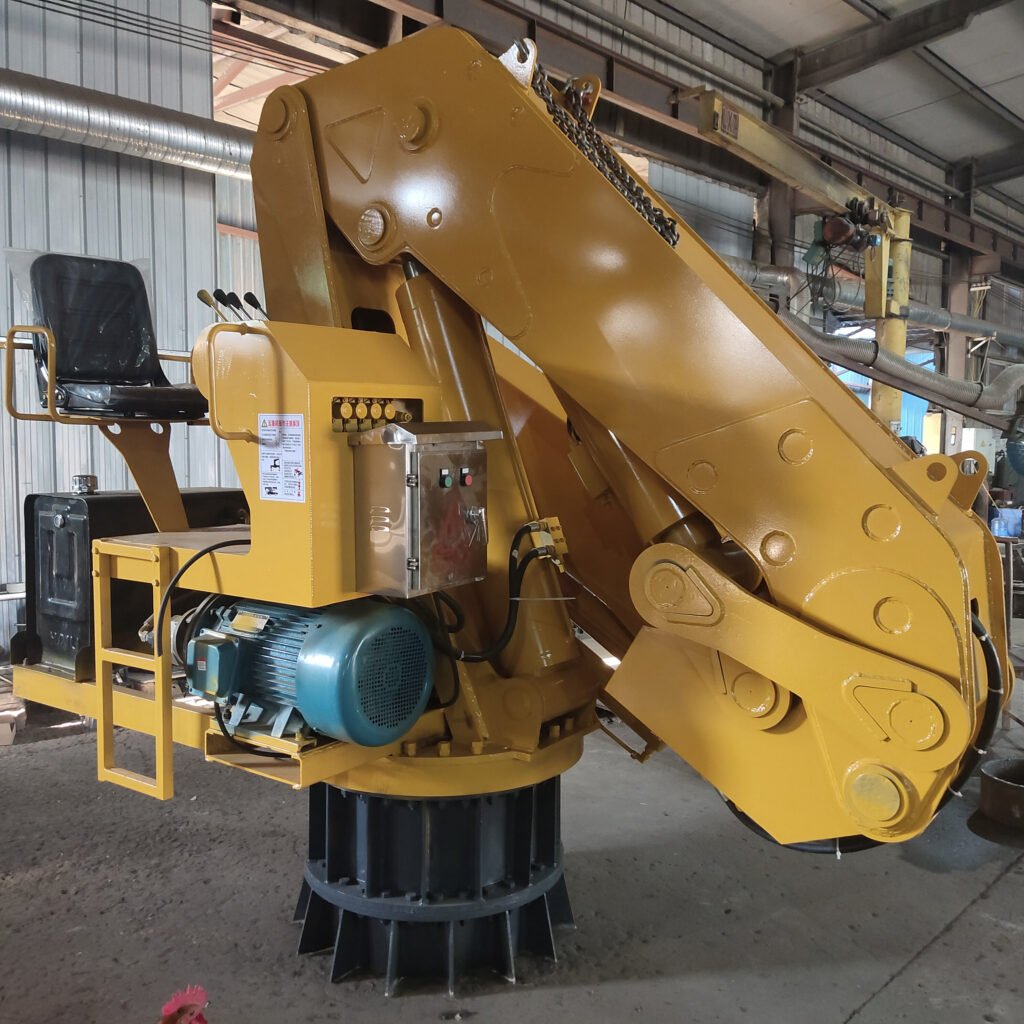
Introduction to Knuckle Boom Cranes in Modern Logistics
In today’s competitive logistics landscape, businesses constantly seek innovative solutions to reduce operational expenses while maintaining productivity. Among the most transformative technologies reshaping the industry are knuckle boom cranes, also known as articulating cranes or pick-and-carry cranes. These versatile material handling systems are proving to be game-changers in reducing labor dependency, minimizing workplace injuries, and accelerating loading/unloading operations. As logistics companies like HAITAI strive to optimize their supply chain efficiencies, understanding the labor-saving advantages of knuckle boom cranes becomes essential for maintaining competitive advantage in an increasingly automated industry.
What Are Knuckle Boom Cranes and How Do They Work?
Knuckle boom cranes feature a unique articulated arm design with multiple hinge points resembling a human finger’s knuckles, providing exceptional flexibility and precision in confined spaces. Unlike traditional straight boom cranes, their segmented design allows them to “fold” during transport and navigate around obstacles during operation. This articulation enables operators to reach over barriers, position loads with millimeter accuracy, and handle materials in spaces where conventional cranes cannot function.
Key components include:
- Multiple hinged boom sections for enhanced maneuverability
- Rotating platform for 360-degree operation
- Hydraulic systems for smooth, controlled movement
- Various attachments (forks, buckets, grapples) for handling diverse cargo types
- Compact design for transportation between sites
Direct Labor Cost Reduction Mechanisms
1. Reduced Manning Requirements
Traditional loading operations often require teams of 3-5 workers to manually handle cargo, guide crane operations, and secure loads. Knuckle boom cranes enable a single operator to perform all these functions with precision control from an enclosed cabin or remote control station. This consolidation of labor roles translates directly to reduced payroll expenses, benefits costs, and administrative overhead associated with managing larger work crews.
2. Accelerated Operational Cycles
The precision and speed of knuckle boom cranes dramatically reduce loading/unloading times. Studies indicate these systems can complete loading operations 40-60% faster than manual methods or conventional crane setups. This efficiency means trucks spend less time at docks, drivers accomplish more deliveries per shift, and warehouses process more goods with existing infrastructure. For businesses like HAITAI that manage high-volume logistics operations, this acceleration creates substantial labor cost savings across the supply chain.
3. Elimination of Specialized Labor Dependencies
Conventional material handling often requires workers with specific certifications (forklift operators, riggers, signal persons). Knuckle boom cranes integrate multiple functions into a single system operated by one trained individual, reducing the need for multiple specialized positions and associated premium wages.
Indirect Labor Cost Savings
1. Workplace Injury Reduction and Associated Costs
Material handling consistently ranks among the leading causes of workplace injuries in logistics. The Bureau of Labor Statistics reports that over 30% of warehouse injuries involve lifting-related incidents. Knuckle boom cranes eliminate manual lifting, reducing:
- Workers’ compensation claims and insurance premiums
- Lost productivity from injury-related absences
- Costs associated with hiring and training replacement workers
- Potential liability from workplace accidents
2. Reduced Training Expenses
Training a knuckle boom crane operator requires significantly less time than training multiple workers in diverse material handling roles. The intuitive controls and standardized operation across different models shorten the learning curve, allowing companies like HAITAI to redeploy personnel more flexibly across operations.
3. Lower Employee Turnover
Physically demanding manual handling jobs typically experience high turnover rates, leading to recurring recruitment and training expenses. By transitioning to crane-assisted operations, companies reduce physical strain on workers, improving job satisfaction and retention while decreasing hiring-related costs.
Operational Efficiency Advantages That Translate to Labor Savings
1. Minimal Site Preparation Requirements
Unlike fixed cranes or extensive conveyor systems, knuckle boom cranes require minimal infrastructure investment. Their mobility and compact design allow them to operate in diverse environments—from crowded urban delivery sites to remote construction locations—without costly site modifications or dedicated operators for each location.
2. Versatility Across Logistics Applications
A single knuckle boom crane with interchangeable attachments can perform functions that would otherwise require multiple specialized machines and operators:
- Container loading/unloading at ports
- Warehouse material movement
- Cross-docking operations
- Truck-to-truck transfers
- Precise placement of fragile or high-value goods
3. All-Weather Operational Capability
With climate-controlled cabins and all-weather capabilities, knuckle boom cranes maintain consistent productivity regardless of conditions that would slow or halt manual operations, ensuring labor investments yield maximum returns regardless of environmental factors.
Case Studies: Real-World Labor Cost Reductions
Port Logistics Operator
A European port operator reported 55% reduction in loading crew sizes and 47% decrease in loading times after implementing knuckle boom cranes across their container handling operations. The reduced labor requirements allowed them to reallocate personnel to value-added roles while handling 30% more volume with the same workforce.
Construction Materials Supplier
A North American building materials distributor reduced their yard staff from 12 to 4 workers while increasing daily shipments by 40% after installing knuckle boom cranes on their delivery vehicles. The precision handling also reduced product damage claims by over 60%, creating additional savings.
HAITAI’s Implementation Strategy
As HAITAI expands its logistics capabilities, incorporating knuckle boom technology offers measurable advantages. By deploying these systems at key distribution nodes, HAITAI can optimize labor allocation, reduce dependency on seasonal workers, and create more predictable operational costs while improving service reliability for clients.
Implementation Considerations for Maximizing Labor Savings
1. Right-Sizing Equipment Selection
Choosing appropriately sized knuckle boom cranes for specific applications ensures optimal efficiency. Factors include:
- Typical load weights and dimensions
- Required reach and lift heights
- Available mounting platforms (trucks, trailers, stationary bases)
- Frequency of use and duty cycles
2. Operator Training Optimization
While knuckle boom cranes simplify operations, proper training maximizes their labor-saving potential. Effective programs should cover:
- Safety protocols and risk assessment
- Load calculation and stability principles
- Preventive maintenance basics
- Efficiency techniques for specific cargo types
3. Maintenance Planning
Proactive maintenance scheduling prevents unexpected downtime that could negate labor savings. Modern knuckle boom cranes feature diagnostic systems that alert operators to potential issues before they cause operational disruptions.
The Future of Knuckle Boom Technology in Logistics
Integration with Automation and IoT
Emerging technologies are amplifying the labor-saving benefits of knuckle boom cranes:
- Remote operation capabilities allowing one operator to manage multiple cranes
- Automated load sensing and positioning systems
- Integration with warehouse management systems for optimized workflow
- Predictive maintenance analytics to minimize downtime
Sustainability Advantages
Reduced engine idling time, electric and hybrid power options, and optimized load handling contribute to environmental sustainability goals while further reducing operational costs—an increasingly important consideration for forward-thinking companies like HAITAI.
Conclusion: Strategic Investment for Competitive Advantage
Knuckle boom cranes represent more than just equipment purchases—they embody a strategic approach to labor optimization in modern logistics. By significantly reducing direct labor requirements, minimizing injury-related expenses, and accelerating material handling operations, these versatile systems deliver measurable ROI while future-proofing operations against labor market fluctuations.
For logistics providers like HAITAI, implementing knuckle boom crane technology aligns with core business objectives: enhancing operational efficiency, controlling costs, improving safety records, and delivering superior customer service through reliable, timely operations. As the logistics industry continues evolving toward greater automation and efficiency, companies that adopt these labor-saving technologies today will establish significant competitive advantages in the rapidly changing global marketplace.
The evidence is clear: knuckle boom cranes aren’t merely replacing manual labor—they’re transforming how logistics companies utilize human resources, redeploying personnel from physically demanding, repetitive tasks to more strategic, value-creating roles. This transition benefits workers through improved safety and job quality while boosting organizational productivity—a true win-win innovation in material handling technology.


